

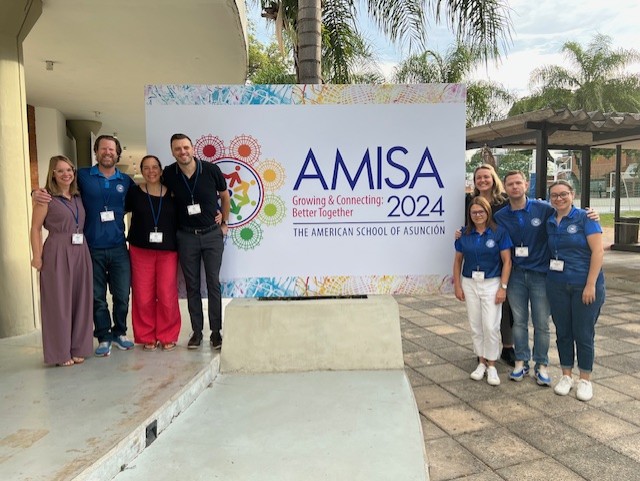
On March 20, 21, and 22 I had the great pleasure to attend and present at the American International Schools in the Americas (AMISA) EdCon, an educators’ conference that brought together teachers, administrators, school staff, and consultants from around Latin America and beyond. The 2024 version was held at the American School of Asunción in Paraguay, a city and country I hadn’t envisioned visiting prior but am now so glad that I did. The school was an excellent site and host for a conference of this magnitude, and the campus was beautiful. The conference itself included key notes and presentations from a wide variety of educational experts, and there were more than a hundred individual presentations from teachers and administrators such as myself ready to share their learning and expertise with others. It was truly three days of learning, laughing, and loving what we do for our students and communities every day.
For me, the journey began with an introductory keynote from Dr. Erick Mazur, a professor of Physics from Harvard University who, in addition to being an expert in a science I can’t begin to understand at this point, has also dedicated his professional career to better understanding how his students learn in order to make complex concepts more relevant and accessible to all learners. Dr. Mazur led over 300 educators through a hands-on activity to demonstrate the power of engaging students in inquiry, and I was immediately inspired to share with others at my table how this related to the work we’re doing at Lincoln around the ideas of “rigor” and student-centered learning.
The rest of my first day at the conference consisted of sessions focused on “Growing Cultures of Greater Inclusion” and “Coaching Teacher Leaders.” Both sessions were again relevant to the work we’re currently doing at Lincoln and both inspired new ideas on how we can leverage the incredible talents of our administrators and teachers to both improve working conditions and the learning environment. I was also able to attend a session led by Beth Goldstein from Babson College who gave an overview of the work she’s done to spread entrepreneurial education around the world and at Lincoln School specifically. It was a great session, and I loved having the opportunity to share how this work has manifested incredible programs at Lincoln School focused on the skills we believe our students will need to contribute not just in the future but also right now. The highlight of the first day for me though was the last session. “Ready, Group, Go” was a session presented by Lincoln’s very own Rob Stauffer. His work on methods for grouping students, and specifically the work he’s done to tie this to their social-emotional safety and skill building, was extraordinary. His session was inspiring, engaging, and heart-felt as many of the participants, myself included, were able to share how this work was relevant either in their own lives as learners or in those of specific students they’ve served.

The second day of the conference kicked off with a keynote from Dr. Eugenia Cheng, a renowned mathematician and musician who has appeared on late night talk shows and in multiple educational conferences to present her work on not just educations students in mathematics but also in creating equitable learning environments that remove exclusionary, or ingressive, practices and behaviors. I followed this talk up with a session on “Creating Classrooms of Inclusivity” from Marla Hunter and then another on “The Power of Entrepreneurship Education” from representatives from the international School of Panama and the University of Delaware. In the latter, it was amazing to hear how Lincoln and ISP are on parallel paths towards creating entrepreneurial learning environments, programs, and matriculation pathways for our students.
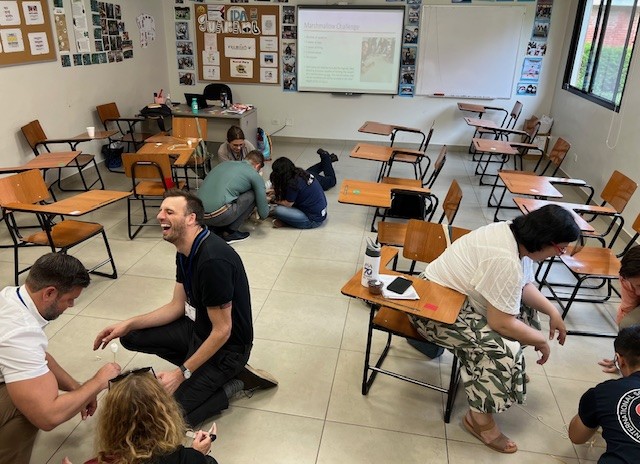
Finally, my turn to present arrived and I shared the activities I developed for Session 2 of the Building Schools of Belonging series of workshops I developed for us at Lincoln School. Short on time, I can’t say it was my best job of presenting these ideas and activities, but the participants who attended my session were engaged and enthusiastic about the work. We took the time to complete the Marshmallow Challenge as a means of discussing the importance of empathy before doing a quick (and too cursory) overview of the activity I put together using the Learning Zone model to take empathy journeys using hypothetical students in real-world situations from our schools. It was over too quickly, but I again left energized and reassured that this work is important and, for lack of a better word, a personal calling.
The third day of the conference was really a half-day. There was no keynote, so jumped right into a few sessions before wrapping things up. Of these, I loved the session I attended on Entrepreneurial Learning with Kenny Horrocks. Kenny is a former colleague from Lincoln and soon to be principal himself. It was great to have time to catch-up and also to hear him speak so passionately about my first love in the world of education: outdoor ed. For me though, the highlight of this day didn’t come in the form of a session but instead in a meeting I had with Beth Goldstein (whose session I attended on day 1) from Babson College. We’ve been working with Babson for years to grow our entrepreneurial programs, and Beth and I were able to take some time to plot out next steps in the evolution of this work in the coming school year. It’s too early to share specifics now, but I can say I am incredibly excited to see the fruition of this conversation as we continue to train teachers and students in entrepreneurial thinking and doing.
And then just like that, it was over. As you can hopefully tell, I thought the conference was fantastic, and I’m so thankful to Dr. Dereck Rhoads and the entire team at AMISA (as well as the team at ASA) for putting it together. I also truly enjoyed Asunción, having had a fantastic night out to dinner on Thursday and a great hotel stay as well. From the conference, my wife (a first-grade teacher at Lincoln) and I, as well as two other colleagues hopped on a plane for a few days in Buenos Aires and Uruguay, but that’s for another blog.
 Please Come to the Principal’s Office