


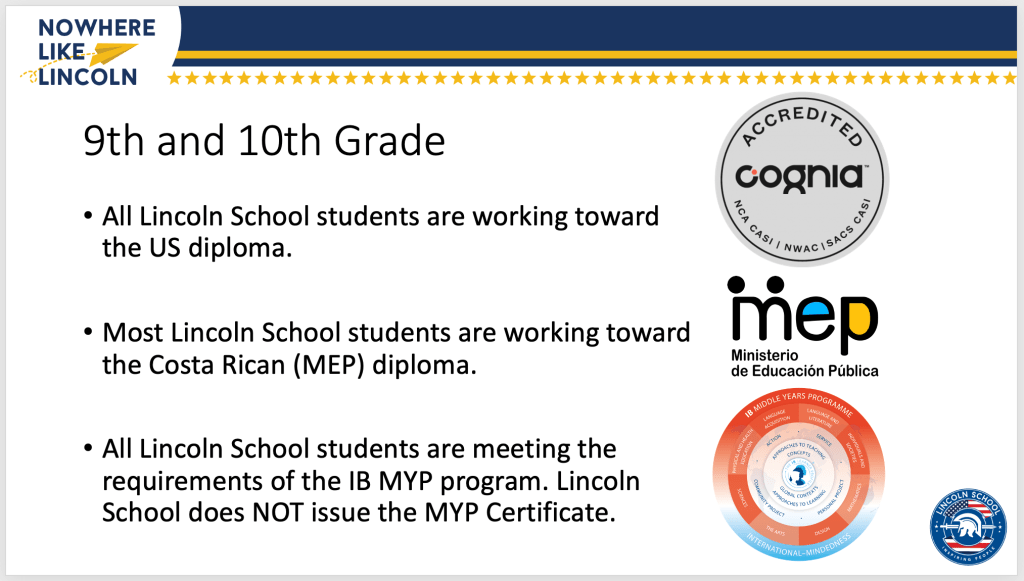
Recently, we held a town hall for our 9th and 10th grade parents to talk about our high school programs and the various matriculation pathways available to our students. It’s actually a complicated conversation here at Lincoln School because we are accredited by three different organizations and we offer students the opportunity to earn up to three separate high school diplomas. We started by reviewing the various accrediting bodies and curricular frameworks that guide our academic programs in grades 9 and 10 and followed that with a quick overview of the same for grades 11 and 12. In short, all students at Lincoln School earn the US diploma through our accreditation with Cognia Education. Most of our students earn the Costa Rican MEP diploma as well, with the only exception being our non-Costa Rican students who do not plan on continuing their education in Costa Rica after graduation. Finally, many (typically around 60%) of our students earn the IB Diploma by participating in the IB Diploma Programme in 11th and 12th grade.

Not only do we offer three diploma options at Lincoln School, we also offer three very different pathways to earn them. These pathways: the IB Diploma Programme, the Entrepreneurial Academy, and the MEP/Certificate Pathway each offer students the opportunity to engage in a rigorous, college preparatory course of study in 11th and 12th grade, but each also offers specific advantages to students based on their college and career goals. This means that students and their parents have a lot to consider before deciding which pathway to pursue.

The International Baccalaureate Programme
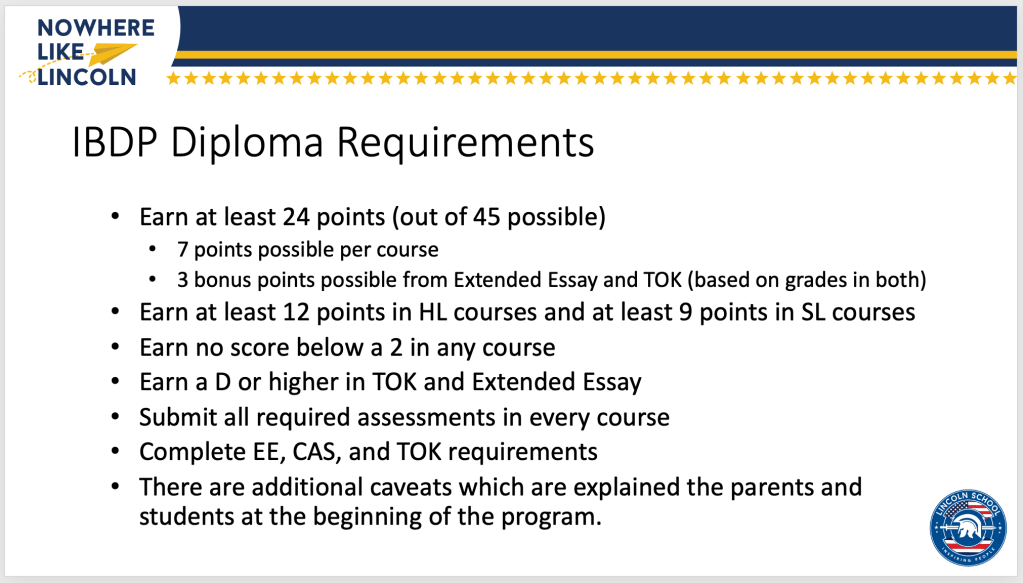
The IB Diploma Programme at Lincoln School is by far the broadest in the region. With over 20 distinct courses to choose from, almost all of them offered at both the Standard Level and High Level, students can focus on the subjects best suited to their interests. Many do; over 60% of our students choose to enroll in the IBDP each year. That said, it is also the most structured of the pathways offered at Lincoln School. Once enrolled, students have very little flexibility in their high school schedules moving forward. This is because students in the IBDP are enrolled in six courses (seven including TOK), all of them two years in length. These courses comprise their entire academic schedule (leaving no additional time for added electives) and cannot be changed once students have completed the first month of 11th grade. Additionally, all students in the IBDP complete an “extended essay” and CAS service requirements, making for a very full schedule of academic work over the course of the two years of the program.
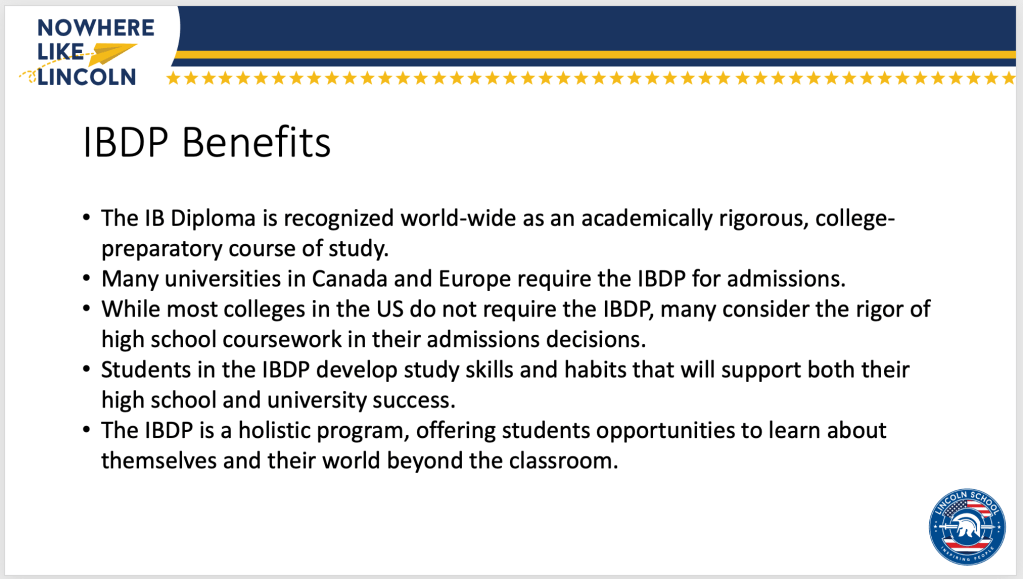
Of course, the Lincoln School IB Diploma Programme also offers students important benefits for completing that work. Graduates of the IB Diploma Program have the ability to apply to university having completed a globally recognized, college preparatory curriculum. Many universities in Europe and Canada consider the IBDP a prerequisite for admission, and universities across the United States recognize the program for its rigor. In fact, many universities in the US and abroad grant incoming students college credit for their IBDP courses, depending on their final scores. Even if they earn no college credit for their accomplishments, graduates of the IBDP learn important research, organization, and study skills while participating in the program.
It must be mentioned that the IBDP does come with costs. First, there are financial costs for participation in the program. The IBO charges each student for participation in individual IB courses and components, or they charge them for participation in the complete Programme. Last year, these costs amounted to a little over $700 for the complete, two-year programme. Other costs are less tangible, such as the time students spend studying for and completing their work, as well as the inability to change their mind about their interests and subsequent course decisions once the program is underway.
While the IBDP is a fantastic college preparatory program, it’s not the right fit for all of our students at Lincoln School. For those interested in a focus on entrepreneurial learning and skills, as well as those who want more options than those presented by the IBDP, we developed the Entrepreneurial Academy.
The Entrepreneurial Academy
Students in the Entrepreneurial Academy still take courses in the 5 “core” areas that are mandated for both the US and Costa Rican diplomas: English, Spanish, IAS, Math, and Science. Those courses may be chosen from our IBDP offerings or from our locally developed coursework. In addition to those courses, students in the Entrepreneurial Academy also take coursework focused on entrepreneurial skills. These courses have been developed by Lincoln School teachers trained in entrepreneurial teaching strategies by faculty from Babson College as a part of our ongoing partnership. Along with the EPIC program, a course developed by Babson College and taken by all Lincoln students in grade 9, these courses train students in the theory and skills they need to ideate, prototype, and develop projects that have the potential for a positive and sustainable impact on their local and global communities.
In addition to their entrepreneurial coursework, students in the Entrepreneurial Academy also have the option of taking up to two asynchronous, online courses from Arizona State University each year. These are actual college courses taught and assessed by faculty from ASU, resulting in college credit and an official college transcript from the University. Students completing these courses will submit an ASU transcript along with their Lincoln School transcript when they apply to colleges in 12th grade.

Like the IBDP, the Entrepreneurial Academy has additional costs. ASU charges each student a one time registration fee of $25 and an additional $400 at the completion of each course in order to receive an official transcript from the University. For those costs, however, students have the opportunity to graduate from Lincoln School having earned significant college credit both from their IB and ASU coursework.
The MEP/Certificate Pathway
Students not interested in the IBDP or the Entrepreneurial Academy follow what we call our MEP/Certificate Pathway. This pathway offers students the most flexibility since beyond the 5 “core” areas students have many electives to choose from. In fact, over the course of the 11th and 12th grades, students in this pathway may take up to 12 elective classes.

A common misconception is that this is the easier of the pathways, when in fact these students are often engaged in our most rigorous coursework. Students in the MEP/Certificate pathway may take up to 6 IBDP courses (opting not to complete the EE or TOK) or they may combine several IBDP courses with others developed locally to meet our students’ college preparatory needs.
For example, the MEP/Certificate Pathway is a common choice for students planning to follow a career in medicine in Costa Rica. To do so, a doctor needs to attend medical school here, and the University of Costa Rica does not recognize the IB Diploma when considering students for admission. Instead, they take into account two factors: students’ grades and their scores on the university entrance exams. For this reason, we have developed a series of science courses designed to prepare students for local careers in the Sciences and medicine. In fact, we’ve done the same in the Maths for students who want to stay in Costa Rica to study for fields such as Architecture and Engineering. For these students, the MEP/Certificate pathway is often the first choice.
In Conclusion
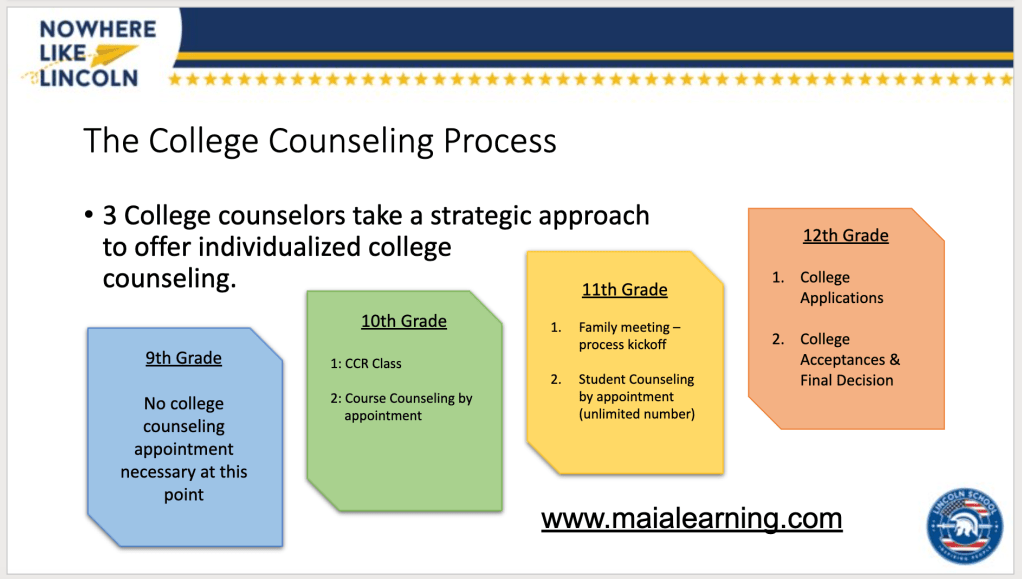
Because the college application process is so important in deciding which of these three pathways a student should follow, our Head of College Counseling was on hand at the town hall to explain some of the intricacies of applying to Universities in Costa Rica and around the world. He also walked parents through the college counseling process from 9th grade through 12th so that parents know what to expect at each stage of their students progression through high school.
Finally, we ended the night with a Q&A session for the parents in attendance. Our parents asked great questions, and we were helped in answering them by our special guests for the evening. For this final 30 minutes of the event, we were joined on stage by students in each of the three pathways. They described their rationale for choosing their particular pathway, their experience so far, and their hopes for the future. It was clear by the end that each had chosen wisely and that their is no BEST pathway but instead a RIGHT pathway for each student. We recorded the event and are sending the recording, along with the PowerPoint from which I’ve pulled just a few slides for this blogpost, to all of our 9th and 10th grade families next week.
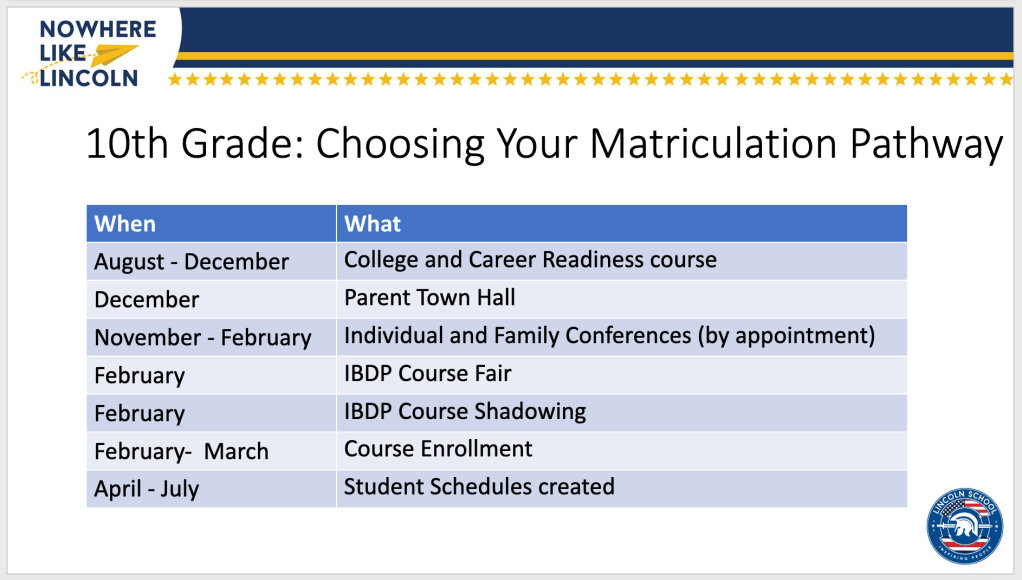
It was a great evening, and an important step in our 10th grade students’ decision making for the course selection process. But it was just one step. We started the year by enrolling every 10th grader into our Career and College Readiness course. There, students spent the semester learning about themselves, their interests, and their potential career goals, as well as learning about the offerings we have for 11th and 12th grade. We also began the process last month of meeting with every student individually in order to help them begin to decide which courses to take. Early next semester, we will hold a series of events for students and their parents in order for them to hear directly from teachers (and other students) about what to expect from each course. And then finally, in March, students will register for the pathway and courses of their choice to begin in 11th grade.
 Please Come to the Principal’s Office